One of the first answers you’ll see when you search this question is, “Yes, especially for content and copywriting tasks.” As Logical Media Group’s Content Strategy Lead and seasoned SEO content marketing writer, I’d like to weigh in.
There have been varied opinions on this topic, especially over the last couple of years as ChatGPT was released and opened to the public. And while some of the marketers I deeply respect have differing ways of approaching the subject, I’ve been shocked to find a few of them landing on extreme sides.
Take this post by Ross Simmonds from about a month ago as an example…
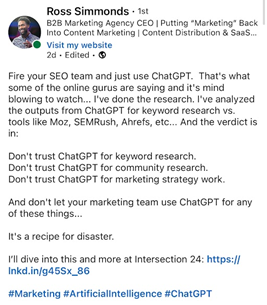
First of all, I’d like to start by saying I think Ross is an incredible marketer and if you dive deeper into the post he shared, you’ll see he’s not as extreme as he sounds here. I have learned a great deal from him over the past couple of years, following him on social media and listening to his various insights into marketing best practices. However, his post took me off guard and was one I knew, immediately, that I disagreed with.
Below is where I think we agree and disagree on the matter and why that is…
How You Should and Should Not Use ChatGPT for Marketing
Don’t fire your SEO team and just use ChatGPT (Agree)
As someone who makes a living as an SEO content strategist and writer, I’d be ridiculous to recommend firing your SEO team and replacing them with ChatGPT; and if someone at your company is recommending it, please don’t do it. Career considerations aside though, it’s not a good move, and here’s why…
- SEO changes all the time. I have been working in SEO for 10-plus years and while a lot of the basics remain the same, the industry changes constantly as you can see from this algorithm updates list alone. It’s a full-time job keeping up with it. Whoever is asking ChatGPT to deliver a comprehensive SEO strategy for your company needs to know where we have been as an industry and anticipate where we’re likely to go based on how Google operates. To manage your SEO efforts effectively, you need marketing experts who can continually adapt to the ever-changing landscape of SEO and take those considerations into account as you’re building marketing strategies.
- Someone has to implement everything ChatGPT tells you to do. ChatGPT isn’t just going to spit out a list of SEO ideas and actually implement them for you. You have to do it. And best-case scenario, if you find a few apps that do it automatically, you still have to manage and review those apps to make sure they’re getting it right
- Google prioritizes the user and when users aren’t happy, changes happen. Then, come the penalties for not following the new guidelines. Survey a few of your friends and family and see if they’ve been happy with the results Google has been giving over the past 6 months or more. If they’re like mine, the answer is going to be no. And what is going to ensure Google continues to stay at the top over other search options? Satisfied users. When users aren’t happy, Google makes changes to its algorithm that can wreck your business if you aren’t careful.
Take it from someone who was first hired in SEO to help a company overcome a Google penalty that was ruining their business — a penalty that wiped them off Google completely until they made the necessary changes needed to gain it all back. You don’t want to fall into Google’s bad graces because you didn’t put the user first. Whatever you are putting out will eventually get reviewed by Google and as algorithms change, you need to stay on top of things.
Don’t Trust ChatGPT for Keyword Research (Somewhat Agree & Disagree)
The name of the game is efficiency, not letting ChatGPT do all the work. While I agree a lot of the outputs ChatGPT gives for keyword research can’t be trusted — most of the results I’ve gotten have returned n/a results as I’ve double-checked Monthly Search Volume and Keyword Difficulty in tools like SEMrush — there is something to be said about ChatGPT giving you a baseline for where to start. Not to mention, as our company strives to expand our work on persona and audience development for our clients, ChatGPT can actually help marketers identify key terms and keywords (not necessarily SEO-focused, per se) to better connect with target audiences. Using this type of language within the copy, headlines, title tags, and descriptions will allow you to more quickly resonate with audiences to increase your site’s traffic and improve conversions on the page.
So my advice… Don’t avoid this tool altogether if you are a seasoned SEO expert. Utilize ChatGPT to generate a list of keyword ideas you can further research using tools like SEMrush, Ahrefs, or Moz. It can provide you with the foundation to get you started and perhaps even surprise you with keywords you hadn’t considered.
Don’t Trust ChatGPT for Community Research (Somewhat Agree & Disagree)
Anyone who has worked for a marketing agency, managing multiple client accounts, likely knows that audience and persona development on behalf of each client is one of the most crucial elements needed at discovery and remains one of the most elusive things to come by. Many companies can provide generic insights into their customers but it often isn’t what’s needed to market at the level companies want to be.
Why is that the case? Because finding the right tools at a rate companies can afford to invest has been challenging, if not impossible.
ChatGPT has laid the groundwork to propel many marketers and companies forward.
Traditionally, if you wanted to understand your audience as a company, you had to pay a third-party agency upward of $50,000 to $80,000 to do so. That’s because there needed to be designated teams diving into the research, interviewing current customers, sending out surveys, etc.
Companies and agencies can now leverage ChatGPT to create an initial framework of persona groupings and profiles, which can then be fine-tuned and developed further. Rather than building these audiences from scratch, you can establish a baseline to refine with additional research for each category or group. This foundational work can be shared with sales teams for input and adjustments, and continuously improve as your teams interview customers and gather feedback over time.
It’s still a lot of work for your marketing teams to employ, but, with AI, it is much more manageable and affordable than before.
So while I agree that you shouldn’t solely trust ChatGPT for community research, for marketers with little to no information to go off of as they market for clients, ChatGPT provides a good starting point to propel them into the world of persona development that actually provides unique value and insights clients long to know and your marketers need to succeed.
Don’t Trust ChatGPT for Marketing Strategy Work (Somewhat Agree & Disagree)
This is where having a seasoned marketer is critical. To Ross Simmond’s point, companies who have fired their SEO teams and started generating marketing strategies on their own are setting themselves up for disaster.
The expertise and experience marketers bring to the table allows them to utilize ChatGPT to build comprehensive and effective strategies. With AI, you can study your website, look at competitors, analyze keywords, evaluate various opportunities, and then have it compile everything into a streamlined strategy. However, you have to know what you’re looking for and what has proved to be effective and not effective for your industry and market.
Over time, you’ll also see that the outputs for these sorts of tasks in ChatGPT can become very repetitive. Knowing how and what to ask can ensure the results from AI take into consideration your specific brand, products and services, unique weaknesses and strengths, competitors trends, etc., to create an effective strategy that is completely your own while also safeguarding privacy and company information that ChatGPT doesn’t need to have.
Don’t Use ChatGPT to Generate Content (Additional Point to Consider)
Ross does not bring this up in his post, but it is one I want to address because it is an area of marketing that many company owners and agencies are beginning to lean too heavily toward.
And why is it a bad idea?
My coworkers and I have been talking about this from the beginning of ChatGPT’s release, and why we have been hesitant to allow the tool to generate content for us:
- It lacks the Experience in E-E-A-T. Google added the experience to E-A-T shortly before ChatGPT was released. E-E-A-T is a component of Google’s Search Quality Evaluator Guidelines that they use when they evaluate websites who want to show up in search. I presumed then that this was a preventative measure to ensure companies and agencies didn’t misuse AI in their marketing efforts. Users want to know that the information they’re reading is information they can trust. And they don’t think they can get that from a bot.
- It could lead to manual penalties. I’ve been thinking about this since its inception, especially with my background in managing a severe Google penalty: Google will eventually penalize AI-generated content, and they have. Search Engine Journal has a great article sharing some of the key insights from Google’s March 2024 Update. The companies hardest hit were those with a large amount of AI-generated content.
- It’s not always very good. There are times when I’ve asked ChatGPT to give me an article on a certain topic, so I could see what kind of information it would cover. The content was actually pretty impressive. However, the more I tested it, the more I saw it’s not very creative. It does a lot of the same things over and over again.
How to Use ChatGPT for Marketing, Specifically Content Generation
All that said, similar to SEO, there are ways seasoned content writers and experts can use ChatGPT to make their jobs more efficient. Below are some specific tactics we’ve used AI for in content generation:
- Content outlines. One of the first steps we take before we begin writing, and after we have identified the keywords we want to target, is to create a content outline so we know what information we need to cover in the piece. ChatGPT has made this part of our work more efficient. It does a great job generating content outlines, especially when we ask it to compile one based on competitor insights (what has and has not yet been covered based on current results on the web). This ensures that what we write is something that’s needed on the web and not just the 10th article on How to Apply for a Student Loan.
However, our team still proofs and revises the results. Oftentimes, ChatGPT will throw in a section that isn’t relevant to our clients, or offer repetitive headlines that need work. We’ll modify and correct those things before we start to write.
- Content briefs. Some of the clients we work with have in-house content teams who can generate the content needed for marketing. However, we still offer strategic direction for their teams so they know what topics and keywords to cover in their writing for greater SEO benefit. ChatGPT has helped us provide our clients with even more direction for these pieces by allowing us to quickly generate content briefs, similar to the content outlines mentioned above, at a level that offers more clarity and strives to increase audience engagement.
- Identifying blind spots. Although it hasn’t been able to deliver the quality of content needed to meet Google’s E-E-A-T Guidelines, it does understand what’s needed. ChatGPT does a great job offering insights and direction where E-E-A-T has been missed. Add a case study or review here. Be sure to mention this. Etc. You just need to be mindful that you aren’t inputting anything that’s confidential or not meant for public use.
- Fine-tuning content. Finally, once your work is complete, ChatGPT makes a fairly good editor, especially if you give it the right ChatGPT prompt for marketing. Can you help me reduce redundancies in this copy? Can you adjust this piece of content to match the tone and voice of this site?
Don’t Let Your Marketing Team Use ChatGPT for Any of These Things (Disagree)
As you can see from what I mentioned above, there are a lot of benefits to letting your marketing team use ChatGPT. Not doing so will deprive them of opportunities to do more with less. Perhaps they could have accomplished more projects for the year or tried new strategies and tactics they often lack the time for, better stayed on top of trends and updates in the industry, etc., had they been allowed to utilize ChatGPT for the tool that it is.
Where Does Marketing Go From Here
Hopefully you’re starting to get a better idea of where I stand on the issue. Where I do agree with Simmonds wholeheartedly is not letting ChatGPT do all the work for you, and especially not in your content and copywriting tasks as many are being led to do. Like everything else mentioned, ChatGPT needs to be seen as the tool that it is for marketing strategists and experts to use to help them be better and more efficient at their jobs.